
"Waiting for Godot" [2026]
- NeonLights

- Mar 8
- 4 min read
Updated: Mar 8
"Nothing happens, nobody comes, nobody goes, it's awful" - Estragon

Stage
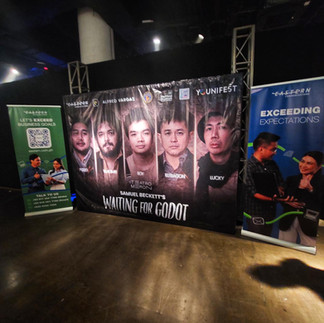
Tarek El Tayech, JJ Ignacio, John Sanchez,
Lenard Tiongson, Yael Ledesma
Playwright: Samuel Beckett
Directed by: Ron Capinding
Special Exhibition Hall, The Mind Museum
Teatro Meron
==========
RATING: ⭐⭐⭐ / 5
==========
🚨SPOILERS AHEAD🚨
SYNOPSIS:
On a desolate country road near a single leafless tree, two wandering companions, Vladimir and Estragon, wait endlessly for a mysterious figure named Godot. As days bleed into nights, they fill the silence with vaudevillian bickering, philosophical musings, and desperate attempts to pass the time. Their vigil is interrupted only by the bizarre arrival of the tyrannical Pozzo and his servant Lucky, whose chaotic presence underscores the absurdity of their static existence.
[Source: TeatroMeron]
INTRODUCTION:
I have a personal history with this play, not because I’ve performed it before, but because it was given to us by our director back in college. I remember feeling confused and lost at that time, struggling to make sense of its plot. The script was hefty, with long monologues, and focused mainly on just two characters. I have to admit, I felt scared and anxious, even doubting whether we could ever pull it off. Ultimately, my co-star and I didn’t continue with the project due to school demands and other responsibilities, and it was shelved.
Now, seeing Teatro Meron bring this play to life stirred a mix of excitement and a little regret thinking that once in my life, this play landed on my lap and didn't find the time to appreciate it. Still, I came to watch and remain to be open-minded about it.
STORY:
The story stays true to its original intent. This play poses philosophical questions that make the audience reflect on their value and existence, and while there are many layers to uncover, I’ll focus more on the impact it had on me.
If you’re unfamiliar with the play, it can be confusing at first, since the story may seem like it’s going nowhere, which, in a sense, it is. The method applied here is called Absurdism, developed by Albert Camus, which explores how humans search for meaning in a world that may not have any. While the characters wait for Godot, questions about their backstory or Godot’s identity remain unanswered. Despite this, the play never felt boring. I stayed engaged throughout, listening carefully to what the characters were really saying beyond the long monologues, constant arguing, illogical bursts of anger, and endless hope for someone—or something—that may never come.
CHARACTERS:
Tarek El Tayech (Vladimir)
Vladimir is the more hopeful and philosophical of the two main characters, eager to wait for Godot and motivated to keep going. Tarek’s performance in this play was impressive. His mannerisms, stage presence, and delivery of lines were superb. Even the uncomfortable moments of the character felt authentic, executed with professionalism and conviction.
JJ Ignacio (Estragon)
Estragon is forgetful, irritable, and constantly complaining, yet he remains devoted to his companion. JJ matched Tarek’s performance well, giving both characters equal stage presence. I especially admired JJ’s accent, it was convincing, clear, and consistent throughout.
John Sanchez (Pozzo)
Pozzo, the wealthy and arrogant man, was portrayed excellently. John’s commanding voice and ability to shift between seriousness and humor kept me on edge and made his presence compelling and entertaining.
Lenard Tiongson (Lucky)
Lucky’s character is, I think, the most physically demanding role in the play. He is Pozzo’s servant and is not allowed to move unless spoken to. While standing in an uncomfortable pose, Lenard also has to carry multiple props and convey consistent emotion using only his facial expressions for, I believe, more than twenty minutes. His control, consistency, and focus on the character make his performance a job very well done.
Yael Ledesma (Boy)
The Boy delivers Godot’s messages and adds mystery to the play. Yael portrayed this role effectively, creating doubt about his character’s true nature and intentions. Even when there was a minor slip in accent, I was not bothered and continued to listen.
PRODUCTION DESIGN:
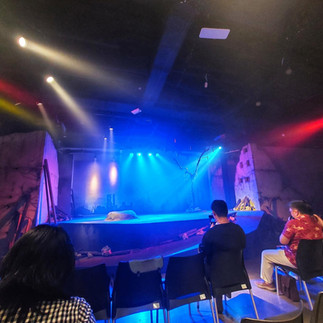
The production design was simple yet effective. The stage and props were well placed, allowing the actors to move freely, while the makeup convincingly reflected the characters’ ages. Music was balanced, not too loud or soft. As for the lighting, for me it is the most prominent element in the production. It has successfully set the tone and environment throughout. Overall, all aspects of production complemented the performances and the story seamlessly.
LESSON:
From this play, I learned about the value of time and waiting. We should make sure that what we wait for is truly important, as life is short and shouldn’t be wasted on trivial pursuits. I also realized the importance of preparing for all outcomes even if that outcome isn't favorable for us. If we just pause and ask ourselves, what if the thing that we've been waiting all this time didn't come? Do we still find the meaning beyond the waiting or remain bitter?
CONCLUSION:
In the end, "Waiting for Godot" isn’t just about waiting for someone or something to come, it’s about the human struggle with time, hope, and meaning. Through its characters, the play shows how life can be unpredictable and absurd, yet people still cling to connection and keep going. For me, Samuel Beckett leaves us reflecting on the routines, uncertainties, and small moments that shape our existence, ultimately encouraging us to seek better versions of ourselves through patience, resilience, and hope.
#TeatroMeron #WaitingForGodot #SamuelBeckett #TheaterReview #StagePerformance #Absurdism #LiveTheater #TheaterLife #PlayReview #VladimirAndEstragon #PozzoAndLucky #DramaLovers #PhilippineTheater






!["About Us But Not About Us" [2026]](https://static.wixstatic.com/media/5b6fd3_8752b4980e474a50b0a2ea1ee67565b8~mv2.jpg/v1/fill/w_980,h_1225,al_c,q_85,usm_0.66_1.00_0.01,enc_avif,quality_auto/5b6fd3_8752b4980e474a50b0a2ea1ee67565b8~mv2.jpg)

!["3 Upuan" [2025]](https://static.wixstatic.com/media/5b6fd3_37365ecf26204312a241de07d8ea9917~mv2.jpg/v1/fill/w_980,h_552,al_c,q_85,usm_0.66_1.00_0.01,enc_avif,quality_auto/5b6fd3_37365ecf26204312a241de07d8ea9917~mv2.jpg)
Comments